
Start with the most searched one, because it settles the argument before we make it.
Pink mold is not mold.
The pink film in your shower is usually Serratia marcescens, a bacteria. It lives on soap scum and mineral deposits, it likes a wet bathroom, and it is not a fungus at all. Fourteen thousand people a month look up pink mold, and the thing they are looking at is in a different kingdom.
Every chart online will still tell you what pink mold means.
A wet spot does not grow one thing
Mold, mildew, bacteria, other fungi — they all want the same conditions. Water, a moderate temperature, something organic to eat. Your bathroom ceiling offers all three, and it offers them to everything at once.
So what you are looking at is not one organism. It is whatever turned up, growing together, in whatever proportion they happened to arrive in. And you are trying to name it with one word, from across the room.
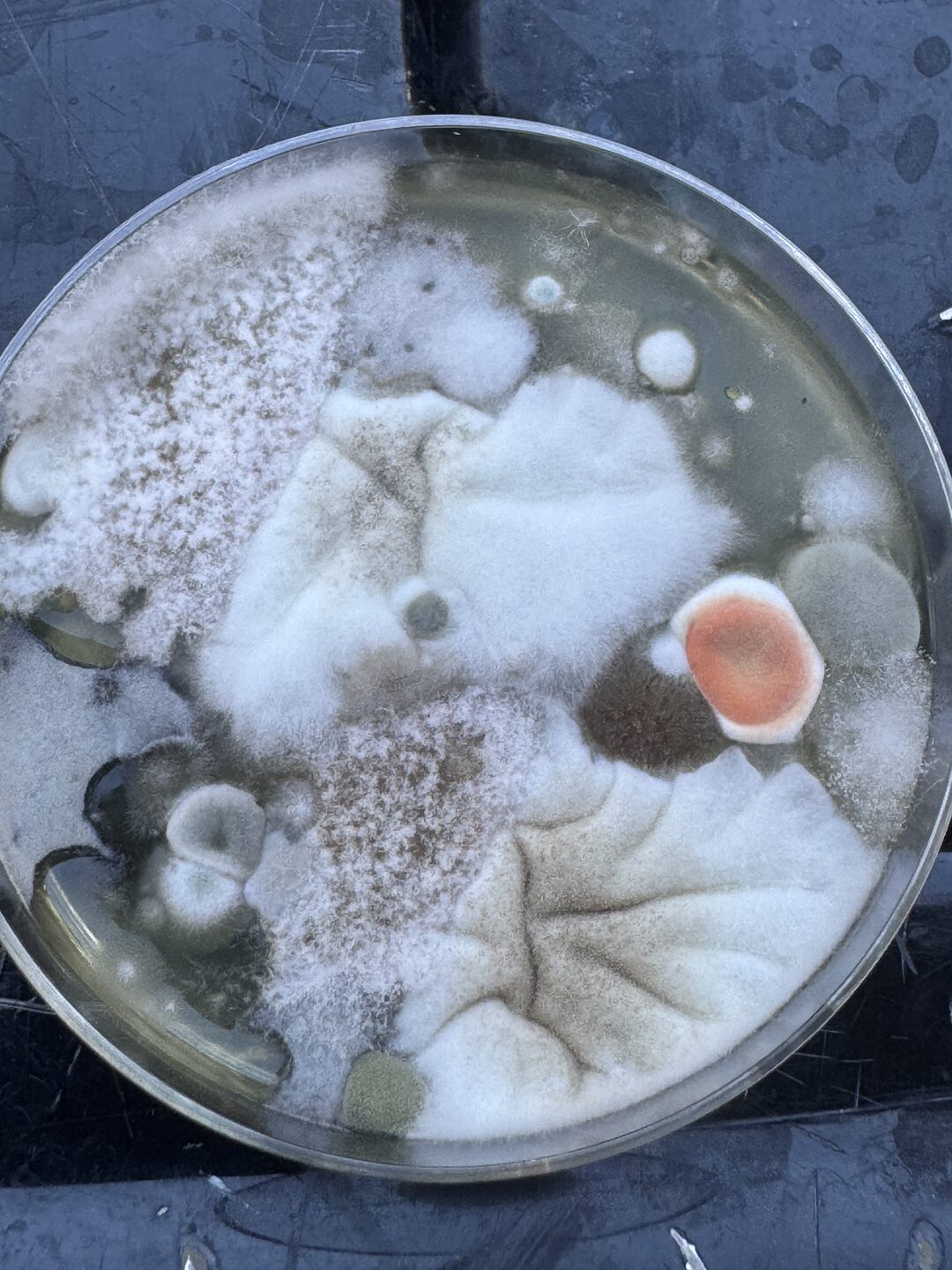
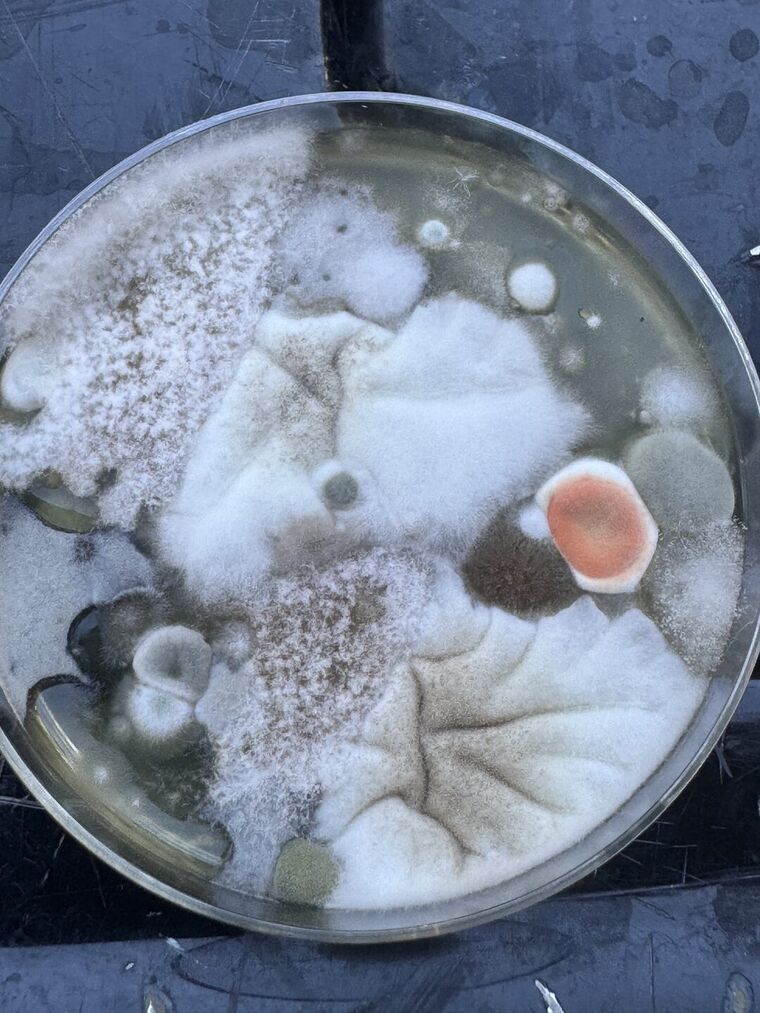
That plate came from a single sample of ordinary outdoor air, left open for one hour. Four days later there were dozens of colonies on it and at least six visibly different organisms — green, gray, white and orange, some fuzzy, some flat, some with rings.
One sample. One hour. Six or more different things.
And one organism is not one color
Even if it were all one thing, the color still would not hold still.
A colony changes as it grows. Color, shape and size all shift with age, and they shift again depending on what it is growing on. The thing you saw last month and the thing you are looking at now can be the same organism at two different points in its life.
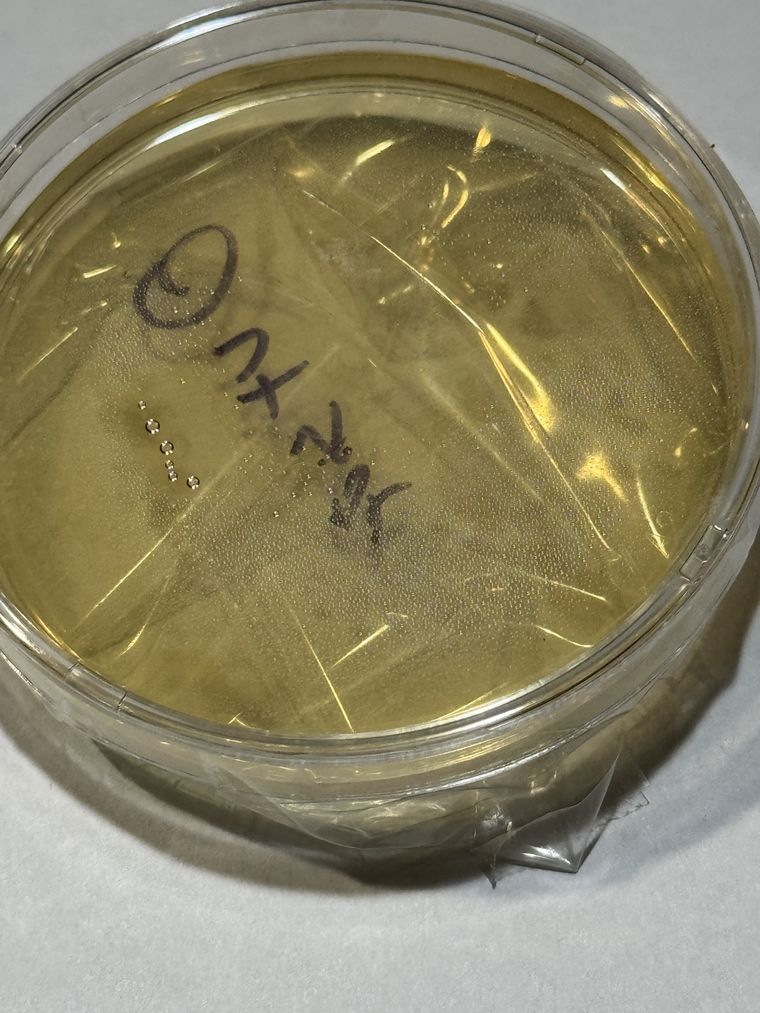
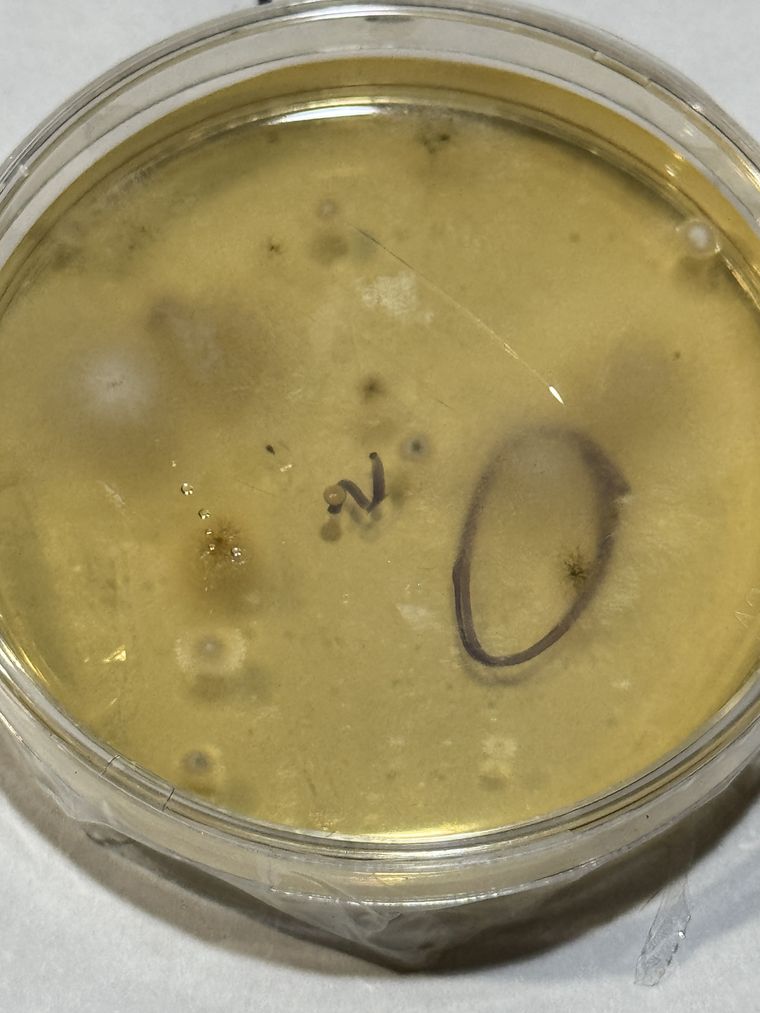
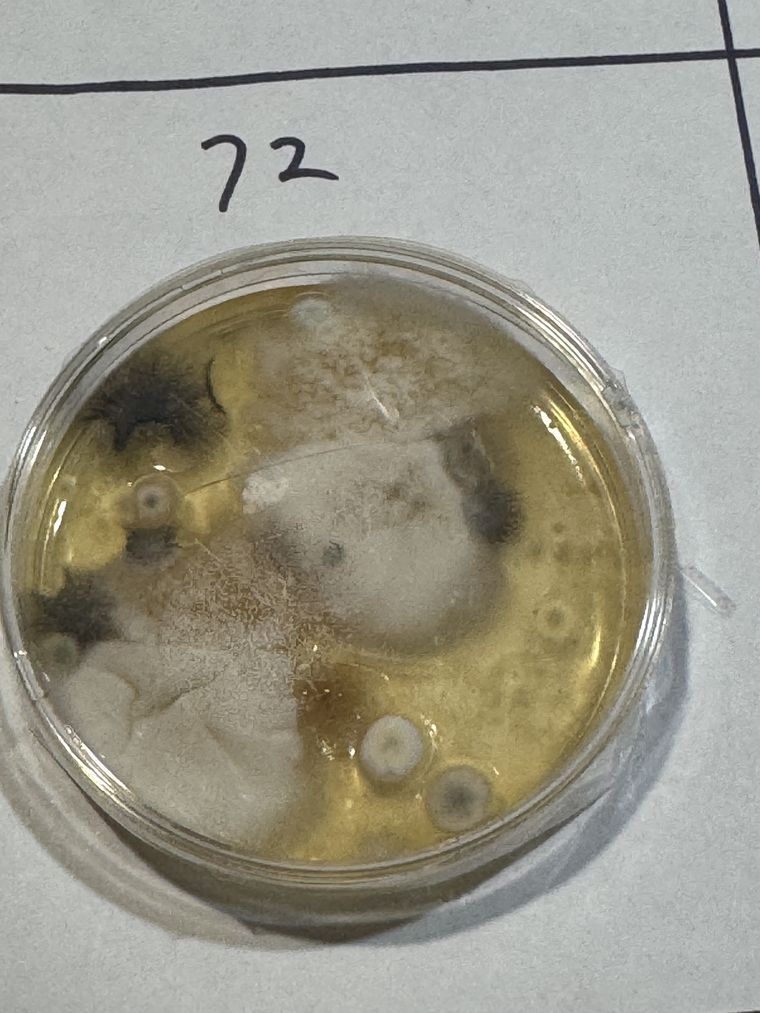
That is the same plate, four days running. Nothing was added and nothing was removed. It just got older.
In a laboratory, color is one item on a list. Identification uses the culture conditions, the colony shape, its elevation, its edge, its size, its surface, its opacity — and its color. One of nine, and the least stable one on the list.
A chart that works off color alone is using the weakest signal in the set, on its own, from a photograph.
Which is why "black mold" names three different organisms
The most famous term in this industry is not a species.
Stachybotrys chartarum, Aspergillus niger and Rhizopus stolonifer all get called black mold. Three unrelated organisms, one word, and that word is the one everybody searches.
Where I find it is a short list, because it is the same places in almost every South Louisiana house. Around supply vents and on the sheetrock next to them. On the bathroom ceiling over the shower. On the back wall of a closet on an outside wall. Behind furniture pushed tight to a wall. On window sills. On the underside of the attic decking. Every one of those is a spot that runs cooler or wetter than the rest of the room.
Some of what people call black mold is not growing at all. Dust pulled onto a return grille, dark lines in the carpet along a wall, an old water stain. From across the room they all look black. Growth has texture, and it comes back after you wipe it. A stain or a dust line does not.
Either way, looking at it will not tell you which of those three it is, or if it is any of them. Only a lab can.
What I say when I am standing in your house
I do not say it is mold.
I say microbial growth, for all of it, every time. Not because I am being careful with my words, but because that is the only accurate thing anybody can say from looking at something on a wall.
Five years doing this exclusively, over a thousand South Louisiana homes, and I still cannot tell you what is growing on your ceiling by looking at it. Neither can anyone else. You would have to pay for a sample to be analyzed by a laboratory, and even then you are getting what was on that swab.
⭐ So here is the part you can actually use. If somebody comes to your house, looks at a wall and tells you what kind of mold it is, they did not test it. They cannot know that. Take everything else they tell you with that in mind.
So what does the color tell you?
Two things, and they are the two that matter.
Something is growing. Not dormant, not left over — actively feeding on something, right now.
Something is wet. It cannot be there without water. The color is not the finding. The water is.
That is the whole payload, and it is the same payload for every color on every chart. Which is the real reason the charts do not help: they are sorting an answer that does not change.
White mold on wood
White fuzzy growth on wood — crawl space joists, attic decking, the back of a cabinet, furniture stored in a damp room — gets treated like the harmless one because it is pale.
It is not a different category. White is a color, and the color does not tell you what it is. Some growth starts out white and turns darker as it gets older. And some white stuff on brick or concrete is not growth at all. It is mineral salt left behind when water dries out of the masonry, and it crumbles to powder instead of smearing.
What white growth on wood tells me is the same thing every color tells me: that wood has been wet long enough to grow something. In a crawl space or an attic down here, that is usually humid air hitting a cool surface, not a leak. Find the moisture and the color stops mattering.
It does not matter what it is
This is the part nobody says out loud, so here it is plainly.
The treatment is the same either way. Find the water, stop it, dry the material, and remove what has already been consumed. That does not change based on what the laboratory would have called it.
And any microbial growth inside your house is not a good thing. We treat all of it as though it is mold, because mold is the worst case — so if you assume mold and handle it properly, you have covered everything else on that wall by default.
You do not need a test to know what to do. You need to find the water.
What the agencies say
They are blunter about this than the industry is.
CDC: "You do not need to know the type of mold."
CDC: "Mold can look like spots of many different colors."
EPA: "In most cases, if visible mold growth is present, sampling is unnecessary."
There is no federal threshold for how much indoor mold is acceptable, and no standard that sorts one color from another. Not informally — there is simply no number to compare anything to.
What we did, and what we still cannot tell you
Worth being clear about, because it is the point.
We ran four plates in a house for four days, photographed them every twenty-four hours, and grew somewhere over a dozen distinct organisms. We have close-up daylight photographs of all of it.
We cannot tell you what a single one of them is. We did not have them analyzed, so we will not guess — and that is after four days of watching them, which is considerably more than anyone gets from looking at a wall.
Do mold test kits actually work? We ran one for four days
What actually matters
Not the color. Three things:
Is it growing? If you can smell it, it is active. That smell is the byproduct of mold feeding on something.
Where is the water? Every time. It is the only one of mold's four requirements you control.
How much material is affected? That is what decides the scope of the work, and it is usually further than where the staining stops. It is also what sets what mold removal costs.
How mold spreads through a house How to tell if there is mold behind drywall
Common questions
What color is the most dangerous mold?
The color does not sort them. Black mold alone refers to at least three unrelated organisms, and a single organism changes color as it matures and depending on what it is growing on. Any microbial growth in a building is worth dealing with, and the response does not change with the color.
Is white mold less serious than black mold?
There is no reading of a color that changes what you do. White growth on wood, for example, still means the wood is wet, and the wet is the problem to solve.
Can a professional identify mold by looking at it?
No, and be careful with anyone who says otherwise. Identification requires a sample analyzed by a laboratory. Without one, the honest term is microbial growth.
Do I need to know what kind it is?
CDC says plainly that you do not. The remediation is the same regardless, because it is driven by how much material is affected and where the water is coming from.
Plate photographs from our own four-day test, South Louisiana, 14–18 September 2026. No brand named.
Sources: CDC — Mold · EPA — Mold testing or sampling · Mammoth Community Water District — Pink stains. Colony morphology and the limits of visual identification follow standard laboratory practice.
Current as of September 2026.