
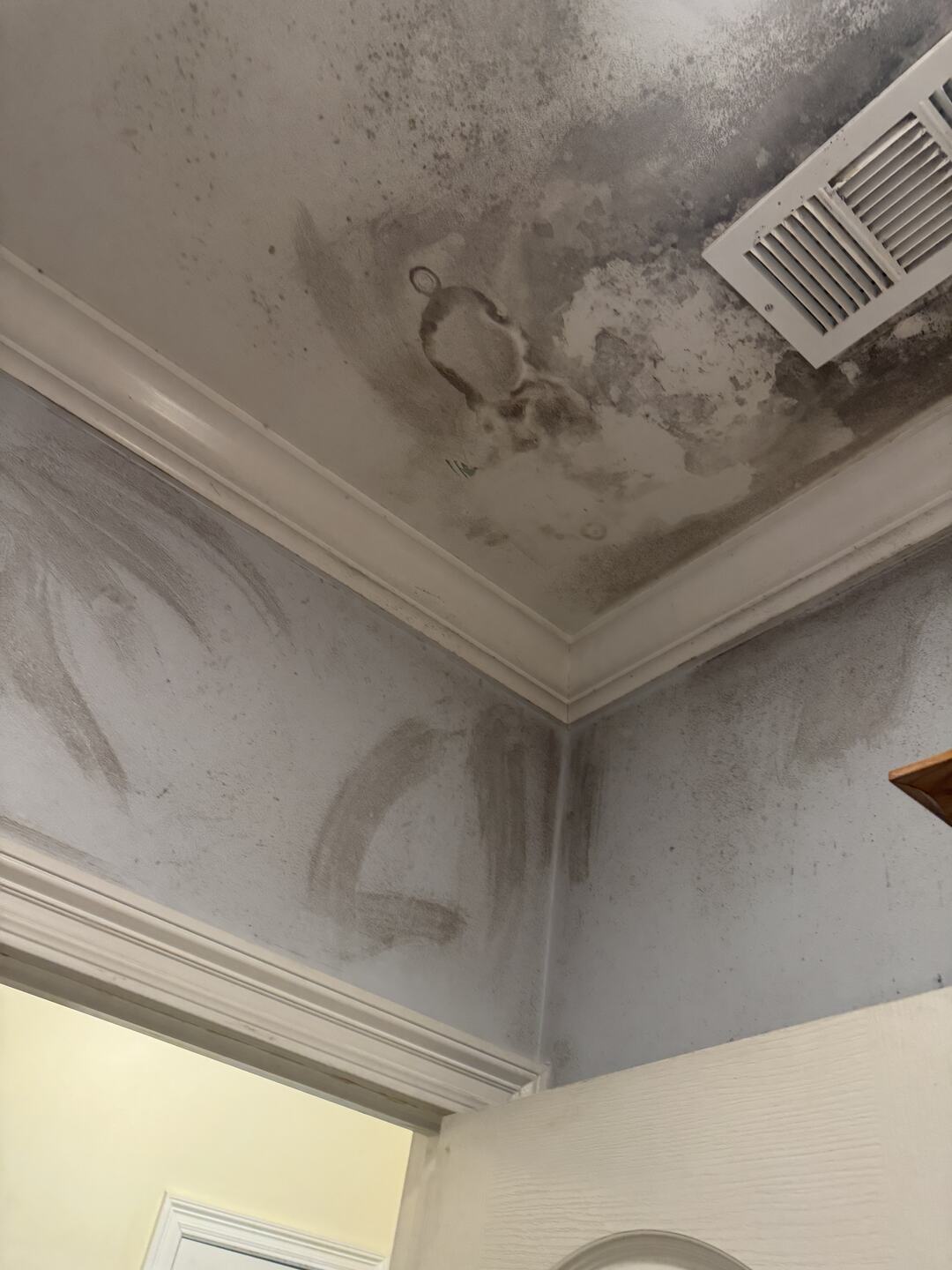
This is the most common piece of advice on the internet about mold, and it is the one we spend the most time undoing. People are not being careless when they reach for bleach — they have been told to, repeatedly, by sources that sound authoritative.
So here is what is actually happening when you spray it.
Why it looks like it worked
Bleach is very good at one thing: destroying color. That is what it is for. Spray it on a mold stain and within minutes the dark speckling fades and the surface looks clean.
The mold is still there. What you removed was the pigment.
Bleaching mold and removing mold are two different things. One changes what you can see. The other changes what is growing.
This is why people are surprised when it comes back weeks later — from their point of view the problem was solved and then returned. It never left.
Why it makes things worse on drywall and wood
Household bleach is roughly 90 to 95 percent water. That matters enormously here.
On a hard, sealed, non-porous surface, the water evaporates and the chlorine does its work on what is sitting on top. Fine.
On a porous material — drywall, wood, trim, insulation, particleboard — the two components separate. The chlorine largely stays at the surface. The water soaks in.
Mold in porous material is not sitting on the surface; it has structures running down into it, the way roots run into soil. So you have just:
- Removed the visible color from the top layer
- Left the growth below it alive
- Delivered a fresh supply of water to the material it is living in
Then the surface dries, looks fine, and the growth beneath continues in a wetter environment than it had before. When it eventually reappears, it is deeper into the material and there is more of it.
The part nobody mentions: disturbing it makes it spore
This is one of the real downfalls of attacking a spot with a spray bottle and a rag, and it has nothing to do with which product is in the bottle.
Mold releases spores when it is disturbed. Scrubbing, spraying, wiping, brushing — all of it agitates the growth, and the growth answers by putting spores into the air. Those spores do not stay in that room. They move with the air in the house, through the hallway, into the return, around the duct system, and they settle on surfaces a long way from where you were working.
So a person cleans one spot in one bathroom, feels like they have handled it, and two months later there is growth in a closet and behind a piece of furniture in another room. They assume it is a coincidence, or bad luck, or that the house is just prone to it. It is neither. It is what got spread on the afternoon the spot was cleaned.
This is the whole reason professional work is done inside containment with the air under negative pressure and air scrubbers running — not because the cleaning is more thorough, but because the spores that get released have nowhere to go.
"But it works on tile and glass"
It does. On a hard, sealed, non-porous surface with nothing growing beneath it — glass, tile, a sealed countertop, a bathtub — bleach will kill surface mold and remove the stain.
We still tell people not to use it, and the reason is practical rather than technical.
"Non-porous" is not a distinction most people can apply while standing in their bathroom with a spray bottle. Someone reads that bleach is fine on hard surfaces, starts on the tile, and finishes on the ceiling, the grout, the trim and the wall. That is the situation we get called to.
The advice that is technically correct and the advice that produces good outcomes are not the same advice here. So our answer is simply: do not use bleach on mold.
One genuine safety point
Never mix bleach with ammonia, or with any cleaner containing it. The combination produces chloramine gas, which is dangerous in an enclosed space like a bathroom. Many glass and multi-surface cleaners contain ammonia and it is not always obvious on the label.
Do not mix bleach with vinegar either — that produces chlorine gas.
If you use bleach for anything, use it alone, and ventilate.
What about vinegar, hydrogen peroxide, or a "mold killer" spray?
People usually ask this next, hoping for a better bottle.
There isn't one, and that is the part that gets left out of most articles. The product is not what decides the outcome. The situation is.
What actually determines whether mold comes back is:
- What it is growing on. Porous or not, and whether that material can be saved at all
- How far it has gone. Surface film, or established inside the material
- Whether the moisture source is gone. This one decides everything
A product can help with the first inch. None of them address the third, and the third is the whole game.
The thing every article about bleach leaves out
Mold is a symptom. It grew because that spot had sustained moisture, and if the moisture is still arriving, it does not matter what you spray — it will grow back on schedule.
In South Louisiana the source is usually not a leak at all. It is an air conditioner that is cooling without dehumidifying, an attic running too hot and pushing moisture down into the house, or a room that traps humid air. A musty smell with nothing visible is that situation announcing itself.
Removing mold without finding the water means paying for the same job twice.
So what should you actually do?
If it is small and on a hard sealed surface
Wipe it off with detergent and water and dry it thoroughly. Then work out why that spot was wet — usually ventilation. Detergent and physical removal is doing the real work; no disinfectant is required for surface growth you can wipe away.
If it is on drywall, wood, trim or insulation
Do not spray anything. Porous material with established growth generally has to come out, and that is a judgment about how far it has gone, not a cleaning decision.
If it keeps coming back
Stop treating the spot. The moisture source has not been found, and that is the actual problem. Recurrence is the clearest signal there is.
If it is bigger than you are set up to handle
Have someone look at it. We are deliberately not putting a measurement on this, because what counts as a small spot to us and what counts as a small spot to you can be two very different things. The honest test is whether you have the containment, the protective equipment and the supplies to do it without spreading it — that is what stops most people, not the size. Disturbing an area without containment distributes spores through the rest of the house, which turns one room into several.
If you have gotten past the point of cleaning it yourself, here is what to ask whoever you call, and here is how to keep it from starting again.
Why we say this when it costs us work
Plenty of the advice online sends people toward a product. We are telling you that in a lot of cases the answer is a wipe with detergent and a ventilation fix you can do yourself for nothing.
That is the honest answer, and it is the same one we give at the kitchen table. Our evaluations are free, and a fair number of them end with us telling someone they do not need us.
Common questions
Does bleach kill mold?
Not usefully. Bleach removes the pigment so the surface looks clean, but on porous materials such as drywall, wood or trim it does not reach the growth below the surface. Because bleach is roughly 90 to 95 percent water, the water soaks into the material and feeds the remaining growth. It does kill surface mold on hard non-porous surfaces like glass or tile.
Why does mold come back after bleaching it?
Because it was never removed. Bleach took the color out of the top layer while the growth continued underneath, and the added water gave it more moisture to work with. It also comes back because the moisture source that grew it in the first place has not changed.
Is bleach safe to use on bathroom mold?
It is not the right tool, and it carries a real hazard: never mix bleach with ammonia or with cleaners containing it, as the combination produces chloramine gas, which is dangerous in an enclosed room. Never mix bleach with vinegar either. For small surface mold, detergent, water and physical wiping followed by fixing the ventilation is more effective.
What actually kills mold if bleach does not?
No single product is the answer. What decides the outcome is what the mold is growing on, how far into the material it has gone, and whether the moisture source has been eliminated. Porous materials with established growth generally have to be removed rather than treated. If the moisture remains, mold returns regardless of what was applied.
Is vinegar better than bleach for mold?
It penetrates porous material better than bleach does and does not add chlorine to the situation, but it is still a surface treatment and it does not address why the material was wet. For small surface growth on a hard surface, detergent and physical removal works as well as either. For anything established in drywall or wood, no spray is the answer.
When should I stop cleaning it myself and call someone?
When it is bigger than you are comfortable and properly equipped to handle — containment, protective equipment and the right supplies are what stop most people, not the size. Also when it has returned after cleaning, when the material feels soft or is staining through, or when it is appearing in more than one room, which usually indicates a whole-house humidity problem rather than a localized one.